
Executive Summary
Indian logistics has spent the last decade getting smarter. ERPs, WMS platforms, TMS systems, real-time fleet tracking, GST compliant invoicing. The inside of the warehouse is digitised. The road outside is digitised. The yard in between is still running on phone calls, whiteboards, and the collective memory of whoever is on shift.
This research report is based on field visits to warehouse and logistics facilities across Kochi, Kerala. It draws on in-person conversations with operations managers, direct observation of yard processes, and an honest assessment of where the pain lies, why it is not being felt, and what fixing it actually looks like.
The most significant finding from these visits is not where the system is broken. It is that the people running these operations do not know it is broken. They have accepted the cost of manual yard management as the price of doing logistics in India. It is not.
This research report sets out what was found, what it is costing, and what the solution looks like for any operations leader managing a busy yard with more than 50 trucks a day and a team that still coordinates by radio.
The Visit That Started Everything
Field Observations: Kochi Distribution Warehouse
A site visit was conducted at a distribution warehouse in Kochi: 45 trucks daily, 15 dock doors, SAP-integrated, experienced operations team.
The following yard and gate operations were observed to be managed entirely manually:
Truck Arrival and Gate Coordination
- Truck arrives at gate; guard calls warehouse by phone to confirm delivery.
- Shipment details verified verbally, with no digital entry at point of check-in.
Documentation and Registration
- Truck and shipment details recorded in a paper register
- No system timestamp; process accuracy dependent on individual guard.
Dock Assignment and Parking
- Dock door assigned verbally, with no system record.
- Truck parked in yard with no position tracking or dwell timer.
Key Observations Across Similar Facilities Visited:
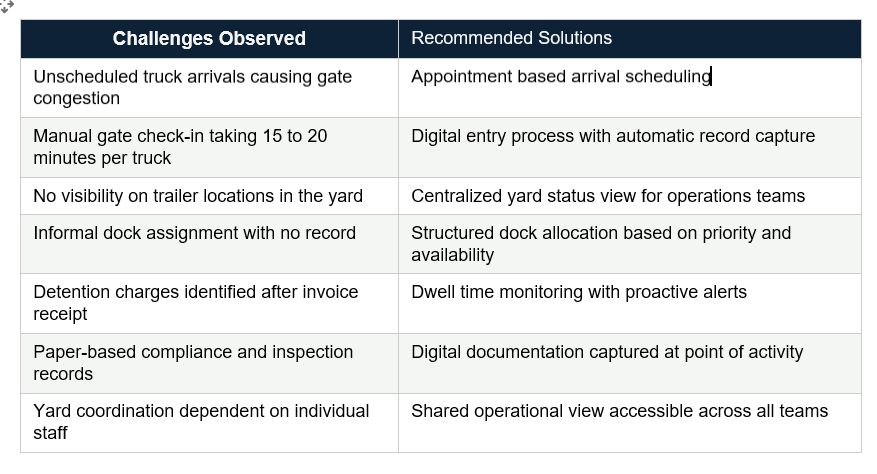
- Gate check-in: 15 - 20 minutes per truck, involving manual paperwork, and phone calls.
- Communications conducted via WhatsApp.
- Trailer visibility: Nil, with no real-time location tracking in the yard.
- Dock scheduling: Verbal, with no digital record or conflict prevention.
- Detention charges: Identified after invoice receipt, with no proactive monitoring.
- Coordination load: One dedicated staff member per shift for yard coordination only.
- Compliance: Paper-based checks, inconsistently applied during peak periods.
The Gap Nobody Has a Name For
Every logistics facility in India has two systems working reasonably well.
- A TMS, managing what happens on the road: trucks, routes, carriers, freight costs.
- A WMS, managing what happens inside the warehouse: inventory, picking, packing, storage.
But the yard in between—where trucks arrive, park, wait, and move to docks—has no system. Every founding assumption about how this space should be managed is wrong.
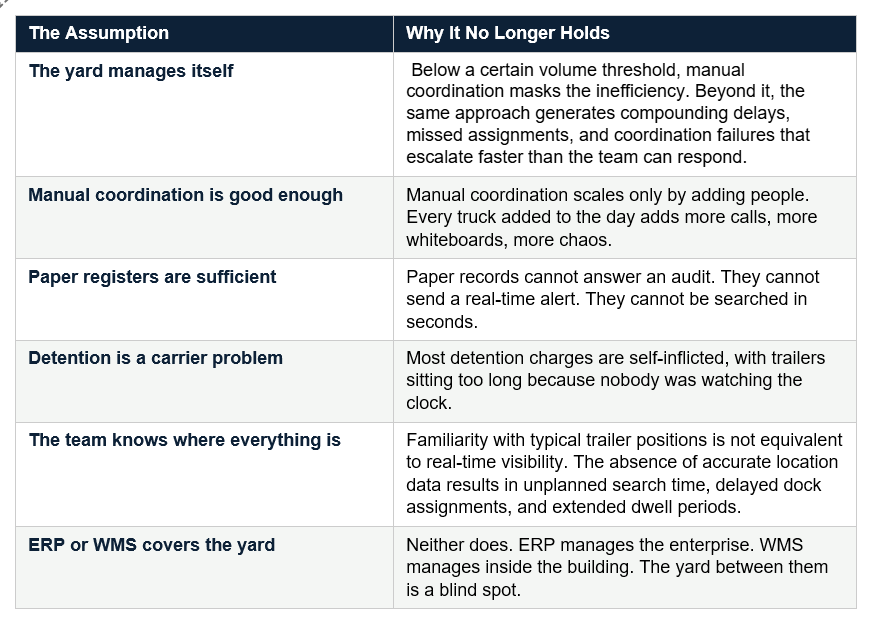
"Every organization running manual yard operations is already paying for a system. It is just a system made of phone calls, paper, and people, and it gets more expensive every time truck volumes grow. "
What the Numbers Actually Look Like
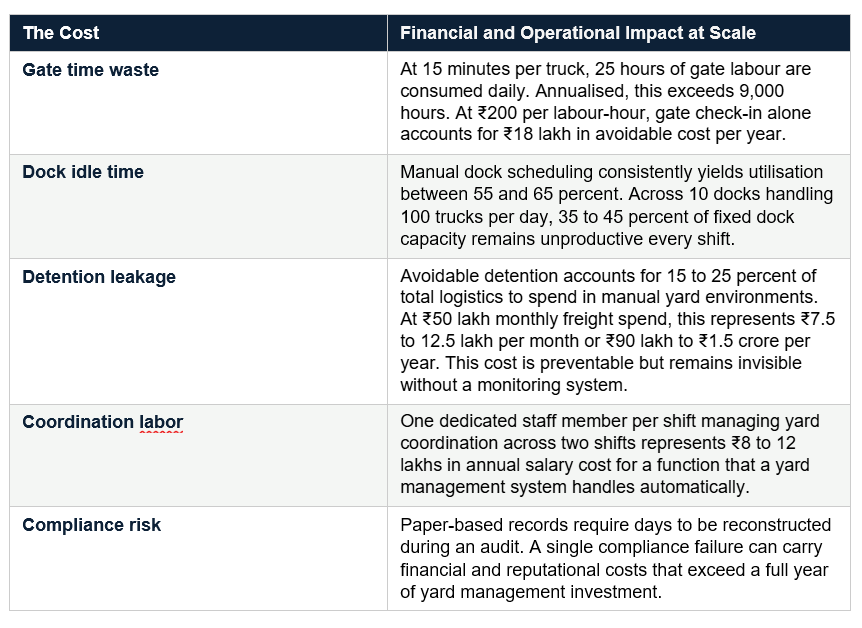
The following cost estimates are derived from direct field observations across the facilities visited. All figures are grounded in on-site data and operational benchmarks, not projections or theoretical assumptions.
The Three Patterns Every Visit Confirmed
Across six facility visits covering different industries, scales, facility types, three patterns appeared without exception.
The Coordination Tax
In every facility visited, at least one person per shift was spending the majority of their working time doing nothing but coordinating: calling the gate, calling the dock, calling the warehouse team, updating the whiteboard. This person is not creating value. They are compensating for the absence of a system. The coordination tax is real, it is paid every shift, and it grows in direct proportion to volume.
The Comfort Zone Problem
Several facilities had developed workarounds, including customized Tally, and WhatsApp groups for coordination, which gave them just enough visibility to feel in control. These workarounds are not solutions. They are pain suppressants. They reduce the acute discomfort of the problem just enough that the team stops looking for a real fix. And while the workaround holds, barely, the underlying inefficiency continues to compound.
The Invisible Pain Problem
The most important pattern, and the most consequential, is that the operations teams running these facilities do not identify their yard inefficiencies as pain. They identify them as the job. This is not a resistance to technology. It is the absence of a reference point. Nobody has shown them what a gate check-in that takes 90 seconds looks like. Nobody has shown them what it means to see every trailer's position on a live dashboard. When you have never seen the alternative, the current state feels like normal rather than a problem.
Capability Gaps in Current Yard Operations
The gaps identified across the facilities visited are not the result of poor operations management. They are the outcome of managing a complex, high volume function without a dedicated system. The introduction of a structured yard management approach addresses each of these gaps directly. The following solutions correspond to the operational challenges observed during the field visits:
What the Solution Looks Like
The facilities visited during this research do not require large-scale operational overhaul. The existing processes, teams, and systems in place are functional. What is missing is structure specifically, a defined and documented approach to managing the yard as a critical operational zone, rather than an informal space that runs on memory and verbal communication.
The recommendations below correspond directly to the challenges observed and are presented as practical operational improvements that any logistics or manufacturing facility can implement.
Structured Arrival Planning
Rather than allowing carriers to arrive at their own discretion, facilities can move to a time slot–based arrival system. Carriers confirm a window before departure. The facility knows in advance what is coming, when it is arriving, and what dock resources will be needed. The result is an even distribution of inbound traffic throughout the day, reduced gate pressure during peak hours, and a warehouse team that is prepared before the truck arrives rather than reacting after it does.
Standardized Gate Entry Process
Gate entry can be reduced from a 15 to 20 minute manual process to a structured, documented check-in that takes under two minutes. The key change is replacing verbal confirmation and paper registers with a defined entry protocol: where the driver presents a confirmation, the guard completes the check-in, and the record is captured automatically. No phone call to the warehouse. No handwritten register. Every entry is documented from the moment it occurs.
Defined Yard Status Tracking
Rather than relying on supervisors walking the yard or calling the gate team, facilities can maintain a running record of every vehicle's current status and location within the yard. This record is updated at each stage arrival, parking, dock assignment, loading completion, and departure. Any team member with access to this record can answer the question "where is this truck right now" without making a single call.
Formalized Dock Allocation
Dock assignment can move from a verbal, ad-hoc process to a documented allocation based on shipment type and priority. When each incoming truck has a confirmed dock assignment before it reaches the dock area, conflicts are eliminated, high-priority shipments are processed first, and supervisors spend their time managing exceptions rather than routine coordination.
Proactive Detention Management
Rather than discovering detention exposure on a carrier invoice, facilities can monitor how long each vehicle has been in the yard against a defined threshold. When a vehicle approaches that threshold, the relevant team member receives a notification in time to act. This converts detention from an unpredictable recurring cost into a manageable and largely preventable one.
Digital Compliance Documentation
Inspection records, seal numbers, and quality checks can be completed and stored digitally at the point of activity rather than on paper registers that are filled inconsistently and difficult to retrieve. When documentation is captured at the moment it occurs, it is immediately available for any internal review, customer query, or regulatory inspection without requiring anyone to search through physical files.
"This is not a complex technology proposition. It is the application of basic digital discipline to the one part of the logistics operation that has been left untouched: the yard. "
What Indian Logistics Is Leaving on the Table
The facilities observed in this research are not failing operations. They are managed by experienced teams running established processes under real operational pressure. The issue is not capability; it is the structural absence of a system designed for yard management.
The yard is the entry point for every inbound delivery and the exit point for every outbound shipment. It is the most operationally significant space in the facility and, in most Indian logistics operations, the least digitised.
Field research confirms that the yard management gap exists across facilities of varying scale, industry, and technology maturity. The financial impact, estimated at Rs 35 to 45 lakh per year at a facility handling 100 trucks daily, is real, measurable, and directly attributable to the absence of a dedicated yard control system. The strategic question for operations leadership is not whether yard management technology is relevant. The evidence presented in this briefing confirms that it is. The question is one of timing
Facilities that establish structured yard management while volumes are at a manageable scale will be positioned to absorb growth without proportional increases in coordination cost, detention exposure, or compliance risk. Facilities that defer this investment until operational pressure becomes critical will face a significantly more complex and costly implementation under conditions of reduced capacity and heightened urgency.
The yard has long been treated as an informal operational space, one that manages itself through experience and manual coordination. The findings of this research suggest that this approach carries a compounding financial cost that most operations teams have not yet quantified. Quantifying it is the first step toward addressing it.
Sources and References
Arrivy. (2025, June 3). 5 dock scheduling KPIs that impact warehouse efficiency. 5 Dock Scheduling KPIs that Impact Warehouse Efficiency
FreightAmigo. (2026, April 14). Demurrage fees 2026: Rates, calc & avoidance. AI logistics, insurance & trade finance platform | FreightAmigo
Fretron. (2026). Detention and demurrage: Glossary. https://www.fretron.com/blog/glossary-detention-demurrage/
DigitRell YardAxis Market Research. (2026, June). Primary field observations and cost estimates from warehouse and yard operations in Kochi, Kerala [Unpublished internal research report].
Start the conversation
If your gate is handling 50 or more trucks a day and your team is still coordinating by phone and whiteboard, that is the signal. We are happy to walk through what YardAxis looks like in your specific yard, and where the first measurable wins are.
benjamin.babu@digitrell.com · +91 8137964387 · yardaxis.com
